Chapter 33 — Private Costs and Benefits, Externalities, and Social Costs and Benefits
Cambridge International AS & A Level Economics (9708) · Unit 7.4 · 4th edition coursebook
Learning objectives
- Define the meaning of a negative externality and a positive externality.
- Define the meaning of private costs and benefits, external costs and benefits and social costs and benefits.
- Calculate private costs and benefits, external costs and benefits and social costs and benefits.
- Analyse negative and positive externalities of production and consumption.
- Analyse the deadweight welfare losses arising from negative and positive externalities.
- Explain asymmetric information and moral hazard.
- Evaluate the use of costs and benefits in analysing decisions.
Key terms
- externality
- Where the actions of a producer or consumer give rise to side effects on others not directly involved in the action.
- third party
- Those not directly involved in the decision-making.
- negative externality
- Where the side effects of an action have a negative impact that imposes costs on third parties.
- positive externality
- Where the side effects of an action have a positive impact that provides benefits to third parties.
- private costs (PC)
- Those costs that are incurred by a consumer or by the firm that produces a good or service.
- private benefits (PB)
- Those benefits that accrue to the consumer or to the firm that produces a good or service.
- external costs (EC)
- Those costs incurred and paid for by a third party not involved in the action.
- external benefits (EB)
- Those benefits that are received by a third party not involved in the action.
- social costs (SC)
- The total costs of a particular action.
- social benefits (SB)
- The total benefits of a particular action.
- deadweight welfare loss
- The loss in welfare arising from an inefficient allocation of resources.
- asymmetric information
- Where one party has more or better information than another in a business transaction.
- adverse selection
- When sellers have information that buyers do not have on product quality or when buyers have information that sellers do not have on product quality.
- moral hazard
- The temptation to take risks when some other party is covering these risks.
- cost-benefit analysis
- A method of decision-making that takes into account the costs and benefits involved.
- shadow price
- One that is applied where there is no established market price available.
- benefit:cost ratio
- Net benefits as a proportion of net costs.
33.1Externalities
For markets to work well, the people who make economic decisions should be the same people who bear their consequences. When a producer and a consumer trade a good or service, their decisions should only affect the two of them. So long as this is so, both sides act with full knowledge of the costs and benefits involved and the market is able to allocate resources efficiently. Problems arise when someone outside the transaction is affected by it. These spillover effects on outsiders are externalities, and the people affected are third parties.
Examples make the concept concrete. Residents living along the flight path of an airport suffer additional noise when flights increase or a new runway opens. A chemical factory that discharges waste into a river kills the fish stocks on which other people depend. A pharmaceutical company that develops a vaccine creates wider benefits if other firms can later use the underlying research. A publicly funded flood barrier protects households and businesses that played no part in funding it. In each case, the well-being of an outsider, or the production capacity of an outside firm, is affected by an action they did not take. It is important to be clear that the externality is the side effect on third parties, not the action itself.
Negative and positive externalities
Externalities can run in either direction.
- A negative externality is one where the spillover imposes unexpected costs on third parties.
- A positive externality is one where the spillover provides unexpected benefits to third parties.
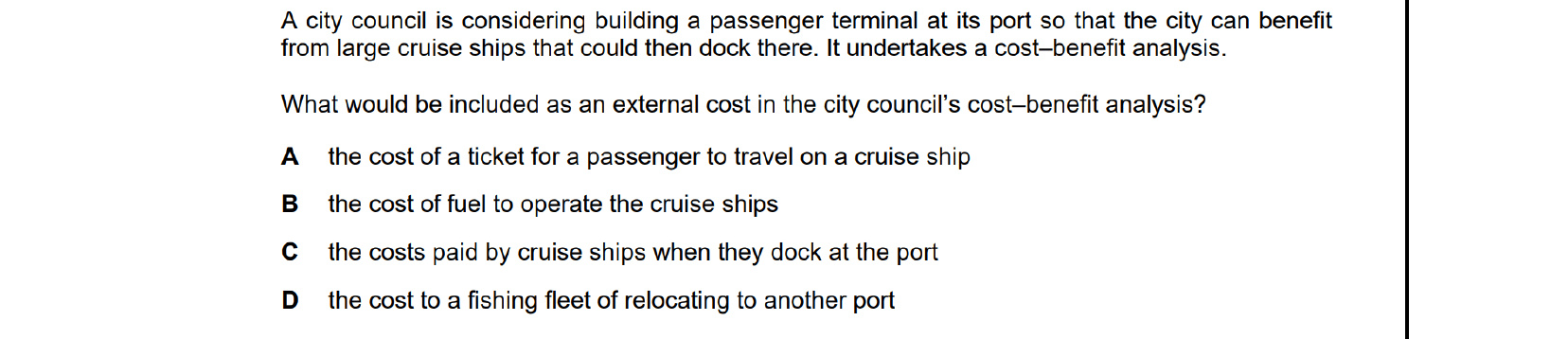
External costs are borne by third parties not involved in the transaction. The ticket cost, fuel cost and docking fees are all private costs paid by parties to the cruise. The cost imposed on a fishing fleet that must relocate falls on uninvolved third parties, so the relocation cost is the external cost that must enter the cost-benefit analysis.

Road congestion costs are imposed on other road users and on third parties (delays, pollution, lost time) and are not borne by the driver causing them. Distribution, energy and labour costs are private costs paid by the firm in production. Road congestion costs are therefore the example of an external cost.
33.2Types of costs and benefits
Economists use three pairs of costs and benefits to describe externalities: private, external and social (see Figure 33.3).
Private costs and private benefits are experienced by the people who are directly involved in the decision to take a particular action. Private costs (PC) are the costs incurred by firms, individuals or others who actually carry out the action, either as producers or consumers. Private benefits (PB) are directly received by those who produce or consume the good or service. In the case of the expansion of an airport, the private costs include the development costs paid by the owners of the airport, and the charges paid by users of the airport such as airlines and passengers. The private benefits include the revenue received by the airport's owners and the advantages that accrue to the additional passengers able to travel to and from the extended airport.
External costs and external benefits are a consequence of externalities that arise from a particular action. External costs (EC) and external benefits (EB) are not paid for, nor do the advantages accrue to, those responsible for the action. Instead they fall on third parties. In the case of airport expansion, people who live on the flight path will experience additional noise pollution; they may be forced to soundproof their homes at their own expense or, in extreme cases, move home. An external benefit could arise if some flights transfer to the expanded airport from elsewhere, resulting in less noise pollution for people who live on the flight path of the other airport.
Social costs and social benefits are the total costs and benefits incurred by or accruing to society as a result of a particular action. Social costs are the sum of private and external costs; social benefits are the sum of private and external benefits:
Social costs (SC) = Private costs + External costs
Social benefits (SB) = Private benefits + External benefits
A problem arises when the private costs do not exactly equal the social costs, or the private benefits do not exactly match the social benefits. The external costs or external benefits distort the efficient allocation of resources. It is for this reason that the market fails to produce the best allocation of resources.
It is possible, however, for the private and social costs to be the same — all of the costs of an action accrue to the individual or firm. In that case there are no externalities. It is also possible that private and social costs differ. If, for example, you decide to take a journey by car, you consider only the costs of the fuel and the time taken. You do not consider the further costs that you may be imposing on others through your contribution to road congestion, atmospheric pollution and possible road accidents. In this situation a negative externality exists, the cost of which is an external cost. This is the case illustrated by Figure 33.3, where private costs are part of, but do not represent all of, the social costs involved in a decision. The vertical gap between the two is the external cost — the cost of the negative externality.
It is equally possible that the social benefits of a decision exceed the private benefits. If this is the case, a positive externality producing an external benefit is said to exist. For example, if you decide to be inoculated against a particular disease, you receive the private benefit of not catching the disease yourself. But you may not be the only one to benefit: the fact that you do not catch the disease also benefits others with whom you come into contact, who will now not catch the disease from you.
Key concept link — Efficiency and inefficiency
A market is not efficient where there are externalities present. Whether a market remains inefficient can be the consequence of the actions taken to tackle market failure.
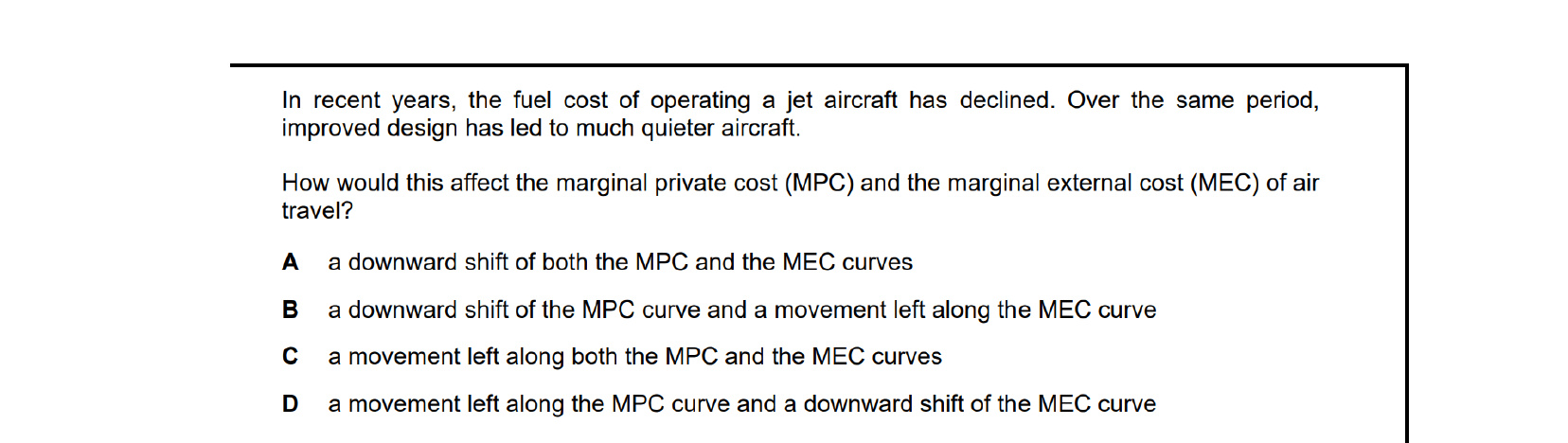
Lower fuel costs reduce a private cost of air travel, shifting the MPC curve downwards. Quieter aircraft reduce the noise pollution suffered by people near airports - a marginal external cost - so the MEC curve also shifts downwards. Both curves therefore shift downwards as their underlying determinants improve, which is the correct option.
33.3Negative and positive externalities of production and consumption
It is also possible to recognise when externalities are the result of production or consumption decisions. This gives four cases — negative production, positive production, negative consumption and positive consumption externalities — each with a characteristic diagram showing the gap between private and social marginal curves and the resulting deadweight welfare loss (see Figures 33.5, 33.6, 33.7 and 33.8).
Negative production externalities
Negative production externalities are spillover effects that occur as a result of production. A common case is most forms of environmental pollution. Suppose a firm illegally disposes of toxic waste, emitting toxic fumes into the atmosphere. A production externality occurs because there are additional costs imposed on the community. Those living near the factory may suffer ill health and respiratory problems, and there is the wider issue of how the toxic emissions contribute to global warming as a negative consequence of the firm's action. There is no cost to the polluting firm.
Another topical example is the growing problem of plastic waste. All economies rely on plastics for many reasons, but disposing of plastic once it has been used is a difficult problem because there are limits to which plastics can be recycled. Much of the waste plastic finds its way into rivers and oceans, causing distress to marine creatures. Some waste plastic enters the food chain, with potentially serious problems when fish and seafood are consumed. Negative externalities of production therefore occur when third parties are harmed by the production of a good or service.
Figure 33.5 shows how negative externalities of production cause market failure. The firm's marginal private cost (MPC) is its supply curve. The marginal external cost (MEC) increases as output increases, and is added vertically to MPC to give the marginal social cost (MSC = MPC + MEC), which lies above MPC. With no consumption externalities, demand equals marginal private benefit equals marginal social benefit (MSB). The socially optimum output Q is where MSB equals MSC. The actual output Q1 in the free market is where MPC equals MPB, which is above the optimum level — there is overproduction, and too much toxic waste is emitted by the factory. The triangular area between the MSC and MSB curves from Q to Q1 (labelled xyz on the figure) is the deadweight welfare loss — the net loss in welfare arising from this overproduction. This is the most widely used example of a negative production externality in exam questions; the diagram must include the deadweight welfare loss triangle.
Positive production externalities
Positive production externalities are benefits to third parties created by producers of goods and services. A typical example is the development, through medical research, of a new medicine or vaccine to combat a serious disease. The recipients of the medication obviously benefit, but there are also wider benefits to others and to the economy as a result of the reduced incidence of disease — including the greater output and productivity from a healthy workforce.
A second example is where new trees are planted to replace those that have been destroyed to make way for a plantation. The people who plant the trees will eventually be able to sell them or sell their crops. The wider community will also benefit through a reduction in atmospheric carbon dioxide. This is an external benefit that is a consequence of planting the new trees.
Figure 33.6 shows the diagram. The marginal external benefit (MEB) of production is subtracted vertically from MPC to give MSC (MSC = MPC – MEB), so MSC lies below MPC. Assuming no consumption externalities, MSB equals MPB. The socially efficient level of output is at Q where MSB equals MSC — above the level Q1 that would be produced in a competitive market (where MPC equals MPB). The external benefits result in a level of output below the socially efficient level — there is underproduction. The deadweight welfare loss is the triangle xyz, resulting from this underproduction. It will only be removed when even more new trees are planted.
Negative consumption externalities
Negative consumption externalities are created by consumers as a consequence of their use of products that result in harm to third parties not involved in the consumption. A topical example is passive smoking, which is now subject to regulations in many countries. Passive smoking causes costs to non-smokers in the form of discomfort and, if long term, respiratory problems due to extensive exposure to cigarette smoke. The cost of treating people who are affected by passive smoking is likely to be paid by those affected or by a public healthcare programme — not by the smokers.
A second example is where, after a big sporting event, the area around the stadium is left in an untidy state with drinks cans and food containers thrown on the ground. Clearing the mess involves a cost to the city authorities, not the owners of the stadium. Noise and anti-social behaviour from those attending the event are further negative externalities that have a negative impact on the lives of residents or those who own businesses close to the stadium. Extra policing may be needed to ensure a peaceful situation returns to the area after an event.
Figure 33.7 illustrates the diagram. The marginal external cost (MEC) of consumption is subtracted vertically from MPB to give MSB; MSB therefore lies below MPB (the demand curve). Assuming no production externalities, MPC equals MSC and is the supply curve. The socially efficient level of output is at Q where MSB equals MSC. Due to the external costs of consumption, the actual level of output is Q1, which is above the socially efficient level. The deadweight welfare loss caused by overconsumption is shown by the triangle xyz. In the case of passive smoking, too much tobacco is being produced and consumed from society's point of view.
Positive consumption externalities
The benefits of positive consumption externalities are the spillover effects of consumption of a good or service on others. This is a key argument for the provision of merit goods by a government. In the case of high school education, students who receive it clearly benefit themselves: their employment opportunities are greater and they can expect higher pay due to their educational background compared with those who left school earlier. The benefits further extend to their families and to their future economic prospects.
A further example is in the provision of healthcare, particularly if it is free. The benefits are felt not only by those who receive treatment but also by their families and the wider economy. If someone avoids serious illness, they are much more likely to be able to provide for their family. A healthy population is also likely to raise living standards and, in turn, achieve a higher rate of economic growth. In both examples, the external benefits accrue to others — not just the individual who receives free education or free healthcare.
Figure 33.8 shows the diagram. The marginal external benefit (MEB) of consumption is added vertically to MPB to give MSB (MSB = MPB + MEB); MSB therefore lies above MPB. Assuming no production externalities, MPC equals MSC. The level of output Q1 is below the social optimum Q where MSB equals MSC. There is underconsumption of both secondary education and free healthcare, and the deadweight welfare loss is the triangle xyz.
When drawing diagrams for these four cases, it is essential to be clear on whether you are dealing with a production or a consumption externality. Production externalities affect the cost curves (MPC and MSC differ); consumption externalities affect the benefit curves (MPB and MSB differ).
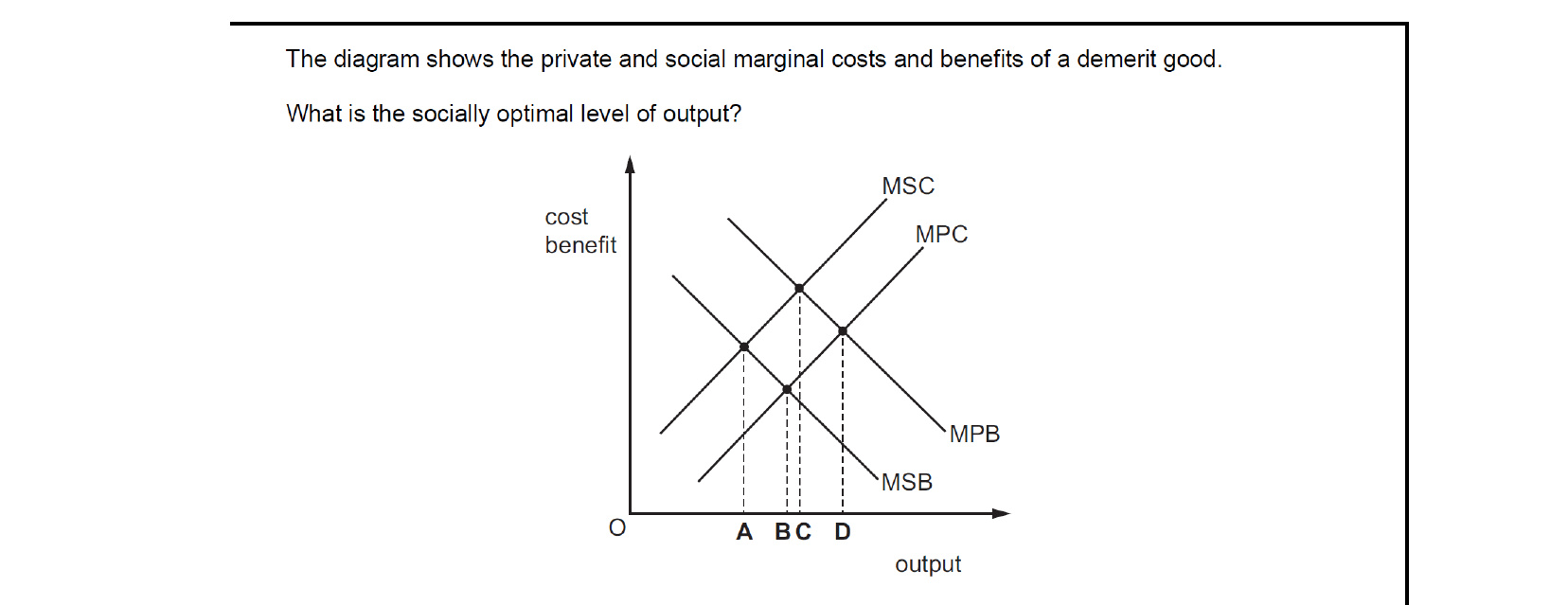
The socially optimal output is where marginal social benefit equals marginal social cost. Reading the diagram, the MSC and MSB curves intersect at the quantity labelled A, so the socially optimal level of output is OA.
33.4Asymmetric information and moral hazard
Markets do not always operate with complete information. Earlier chapters noted that underconsumption of merit goods and overconsumption of demerit goods can result from consumers making decisions on the basis of imperfect information. That earlier analysis assumed information was shared equally by everyone in the market. In reality the quality and quantity of information available to buyers and to sellers often differ, and this imbalance is itself a cause of market failure.
Asymmetric information occurs when one party in a transaction has more or better information than the other. The used-car market is the classic illustration: sellers know the true condition of their vehicle but buyers do not. Buyers, unable to tell good cars from poor ones, will only offer an average price. Owners of high-quality cars will not sell at the average price, so they withdraw from the market. Only poor-quality cars remain, and the market fails. Similar problems exist in healthcare, where doctors know more about medical conditions than patients, and in financial markets, where borrowers know more about their own risk than lenders.
Adverse selection and moral hazard
Asymmetric information takes two main forms.
- Hidden characteristics. One party knows more than the other about a characteristic of the product or person involved. The outcome is adverse selection. Buyers of used cars end up purchasing more low-quality vehicles, driving good vehicles out of the market. Life insurance markets may attract a disproportionate share of unhealthy applicants because healthy individuals do not see enough value in the policy.
- Hidden actions. One party takes actions that the other party cannot observe but which affect them both. The outcome is moral hazard. A borrower who has obtained a bank loan may then take greater risks with the business than the lender realises. An insured policyholder may behave more carelessly because the insurer is bearing the cost of any loss.
Both forms of asymmetric information lead to a misallocation of resources because the uninformed party cannot price the transaction correctly. In Figure 33.7-style terms, buyers lacking information may over-estimate benefits, pushing the demand curve too high, so that too much is bought at too high a price.

Moral hazard arises when one party, once insured, changes behaviour because they no longer bear the full cost of a loss. Designing the contract so that the insurance company and client share any loss preserves part of the client's incentive to avoid the loss, which is the standard remedy and so is the correct option.
33.5Use of costs and benefits in analysing decisions
A useful technique for decision-making, particularly in the public sector, is to lay out and weigh up all the costs and benefits involved in a project. Where the analysis considers the full range of costs and benefits — private and external — it is known as cost-benefit analysis (CBA).
CBA takes a long view and a wide view. The long view reflects the nature of public sector investment — a new road or rail link is typically appraised over thirty to fifty years because the sums involved are large and the benefits accrue slowly. The wide view comes from the need to take account of the full social costs and benefits, not just those falling on the parties directly involved. Major projects often create substantial externalities that affect people and communities with no direct connection to the project.
CBA is widely used for transport projects, environmental decisions and any situation in which the market mechanism is an inappropriate guide. It differs from private sector investment appraisal in two main ways. First, it tries to include all costs and benefits, not just private ones. Second, where no market price exists it must construct a shadow price — for example, a value placed on travel time saved, on cleaner air or on a quieter local environment.
Development of a cost-benefit analysis
A cost-benefit analysis proceeds in four main stages.
- Identification of all relevant costs and benefits. The analyst lists the private costs, private benefits, external costs and external benefits of the project. This sounds straightforward but in practice the external costs and benefits are controversial and difficult to define cleanly, particularly when there is no obvious geographical or physical cut-off for spillover effects.
- Putting a monetary value on each cost and benefit. Where market prices exist this is relatively easy — wages paid to construction workers, materials purchased locally and so on. For variables with no market price, a shadow price must be attributed; valuing time savings is a familiar and contentious example.
- Forecasting future costs and benefits where the project has long-term implications. Statistical forecasting techniques are used, sometimes of a fairly crude nature, to project costs and benefits over many years.
- Decision-making: interpretation of the results. If the value of benefits exceeds the value of costs the project provides a net benefit to the community. Analysts often calculate a benefit:cost ratio — net benefits as a proportion of net costs — and projects with the highest ratios are most likely to be funded, subject to the funds available.
The four stages provide a clear framework for decision-making in situations where the market mechanism is not fully functional, but the technique should always be seen in this context. The wide view of CBA explains why some projects go ahead when, on a purely financial appraisal, they would not.
Key concept link — Scarcity and choice
Cost-benefit analysis is a well-used technique for dealing with the fundamental economic problem in situations where the market mechanism is an inappropriate way of allocating scarce resources. It forms the basis for decision making by governments, especially in the context of public goods.
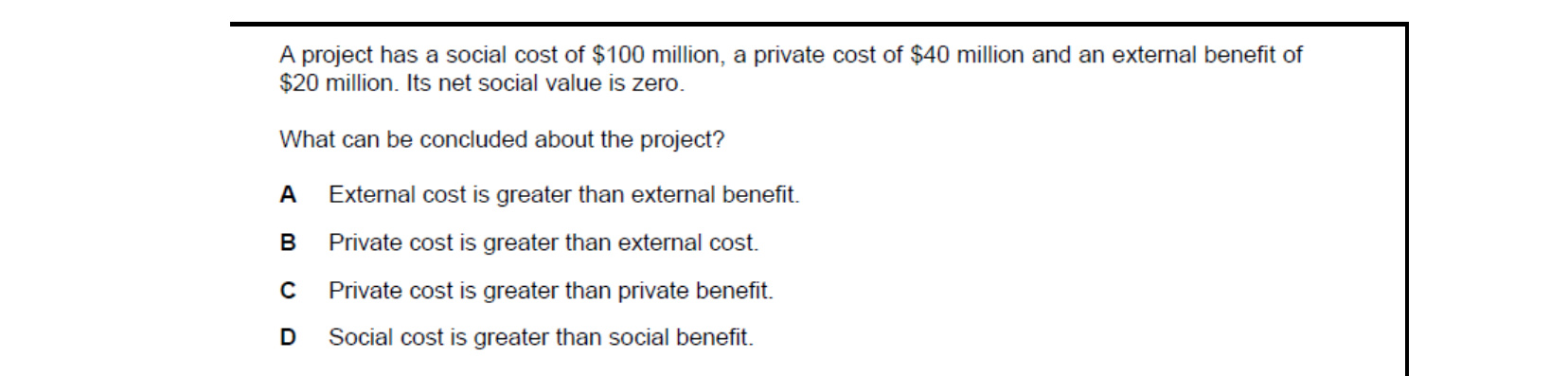
External cost equals social cost minus private cost, so external cost = $100m - $40m = $60m. External benefit is given as $20m. Comparing these, external cost ($60m) is much greater than external benefit ($20m), which is the conclusion that can be drawn directly from the figures.
End-of-chapter practice
Past-paper questions from CIE 9708. Pick A, B, C or D. Answers are saved on this device — press Download report (PDF) at the top to save them.
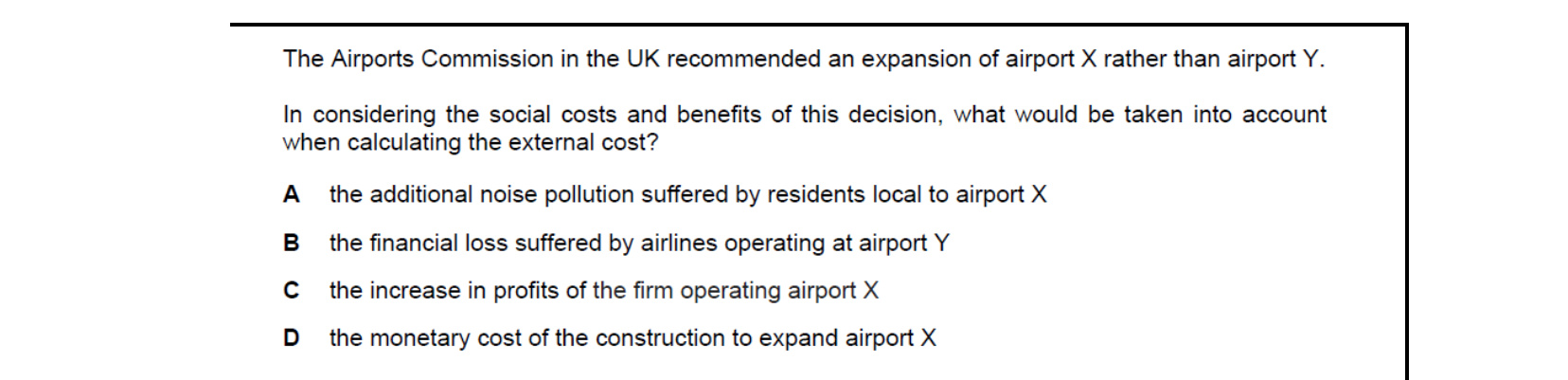
External costs are borne by third parties not directly involved in the airport's expansion. Construction costs and lost profits at airport Y are private financial flows; higher profits at airport X are an internal gain. The additional noise pollution suffered by residents local to airport X is a classic third-party cost, so it is the external cost to include in the appraisal.
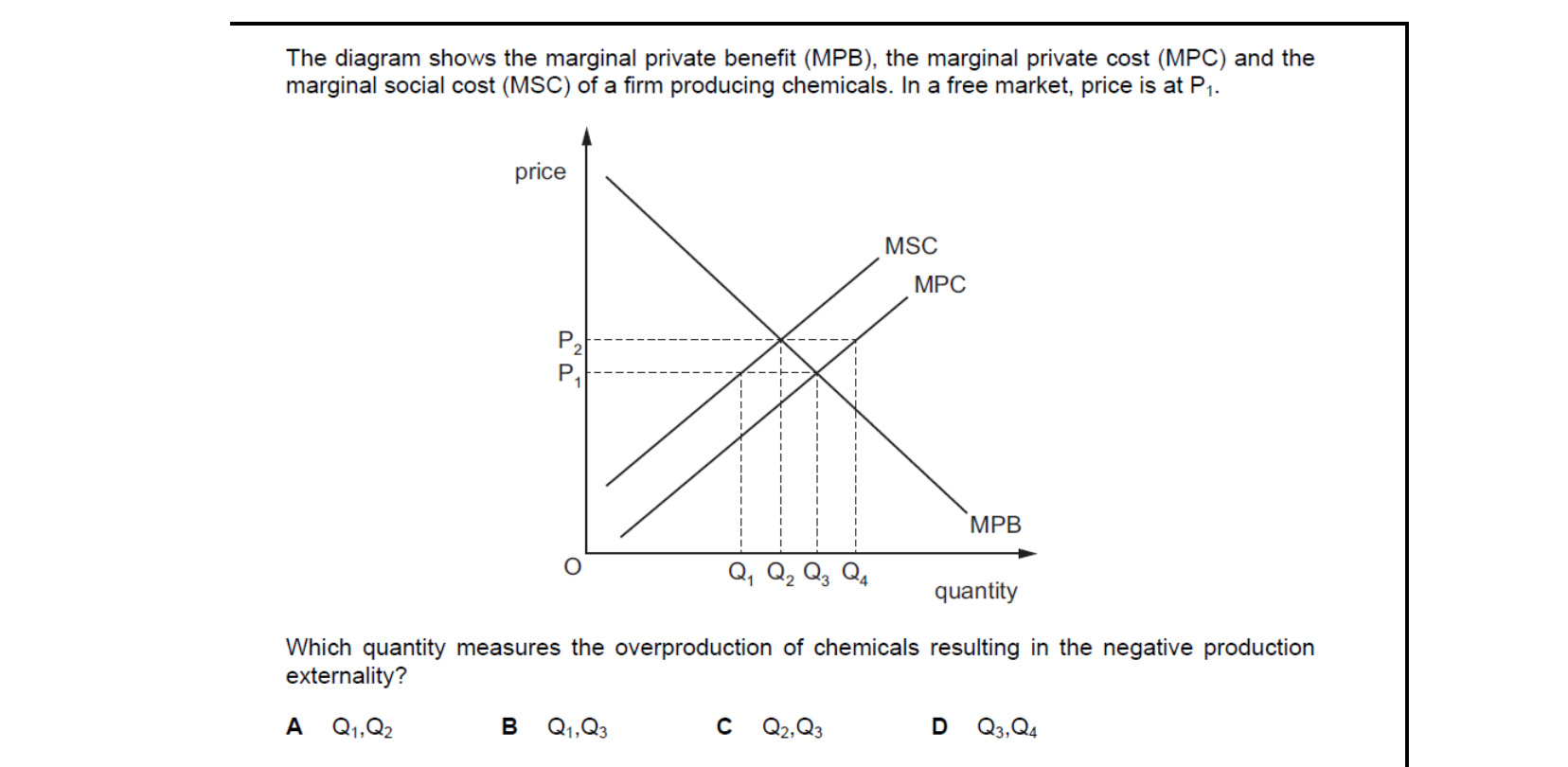
Negative production externalities make MSC lie above MPC. The free-market output equates MPB with MPC (a larger quantity), while the socially optimal output equates MPB with MSC (a smaller quantity). Overproduction is the gap between socially optimal output and free-market output - from Q1 to Q3 in the diagram. So the quantity measuring overproduction is the interval Q1 to Q3.

A negative externality is a cost imposed on a third party not involved in the transaction. Public-good non-provision, ineffective taxation and monopoly pricing describe other market failures or government failures. The production of a good that has a harmful effect on a third party - for example, a polluting factory - is the textbook example of a negative externality.
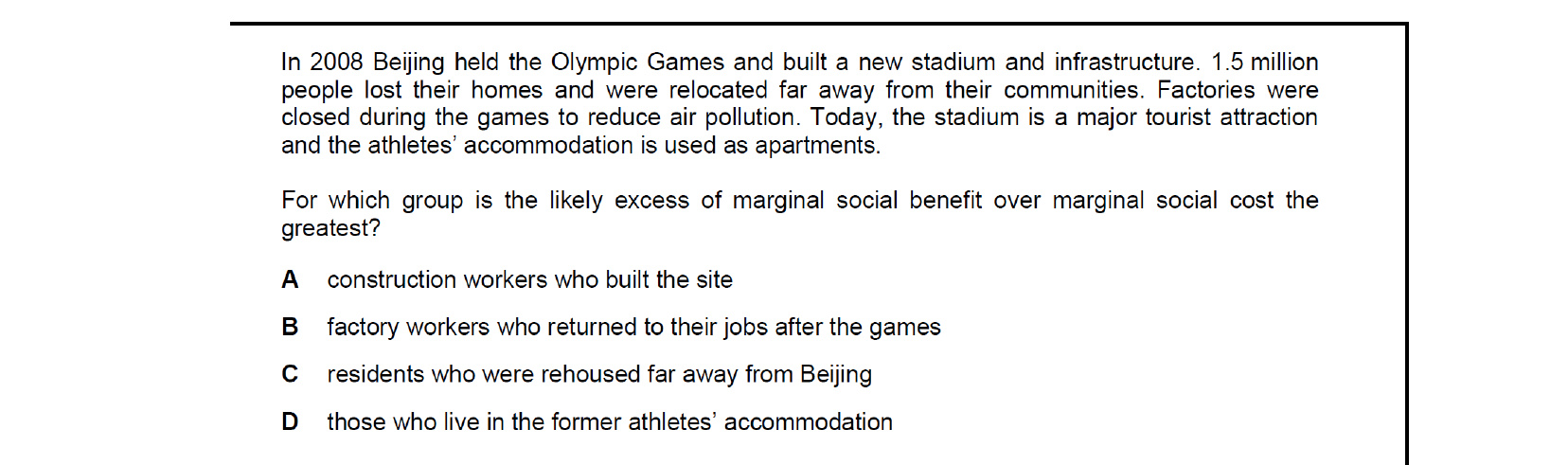
The excess of MSB over MSC is largest for those who gain the most lasting social benefit at the lowest ongoing cost. Construction workers and factory workers had short-term gains; relocated residents bore high social costs. Those now living in the former athletes' accommodation gain durable housing benefits with little continuing social cost, so for this group MSB minus MSC is greatest.
Attempt the practice questions above to build your score.
Self-evaluation checklist
After studying this chapter, you should be able to:
- Understand that the social costs of an activity is the sum of private costs and external costs.
- Understand that the social benefit of an activity is the sum of the private benefits and the external benefits.
- Explain that a common example of market failure is when there are externalities arising from the actions of others in the market.
- Understand and calculate the main types of costs and benefits used to describe externalities: private costs and benefits, external costs and benefits, social costs and benefits.
- Explain how negative and positive externalities may be the result of production decisions or consumption decisions.
- Analyse why externalities in the market may result in deadweight welfare losses.
- Explain why asymmetric information and moral hazard are features of markets where there is information failure.
- Evaluate the use of costs and benefits in analysing decisions.
Want more practice? Drill this chapter's past-paper MCQs (130 questions) →